
Walking the Planet: Pimples of the Planet
Preface
I’m starting this project in which I’ll create one journal entry for each landscape I’ve seen. Each time I’ll have my own list of “The Most”s, and other things that come to mind when I think and see the landscape, that I wanted to write down before I forget.
The one you’re reading now is about volcanoes and geothermal landscapes; coming soon will likely be about seaside/islands or sand/rock dunes. I just came back from Lassen Volcanic National Park in northern California not long ago, and I observed many funny resemblances between this and the other volcanic places during the trip.
The Mosts
Most Classic: Kilauea, Big Island of Hawai’i
Kilauea at the Volcanoes National Park in Hawaii is the first “active” volcano I’ve ever seen in my life, and by far, also the last. I put “active” in quotes because, by definition, any volcano that has erupted recently, or will erupt in the near future, should count; the way I mean it, though, was the one that looked like the illustrations from my childhood textbook: A mountain with a top hallow that is actually spitting fire.
My friend and I arrived at Hilo Airport on the east side of the Big Island in an October afternoon, and by the time we settled down, finished dinner, and made the one hour and a half drive from Pahoa to Mauna Loa Lookout, it was late in the night, and the top of Mauna Loa was freezing - 5℃ if I remembered correctly, and I didn’t have a winter coat. I got out of the car, looking at the wrong direction, shuddering, and wanting very much to get back into the car.
Then my friend called me from behind the observatory. I ran over and I saw it, the sight that fulfilled all my childhood imaginations about volcanoes.


As I was taking hundreds or thousands of pictures, I felt the excitement bursting out like fire, and I took off my jacket. How could the cold bother me anymore, when two “active” volcanoes are within reach, one just across the valley, and another inside of me?
I’d call it the experience of a lifetime. If you ask me to pick the only volcano you will ever visit in your life, this is it. (Or maybe Versuvius, which I haven’t visited yet.)
Most Chromatic: Yellowstone
Yellowstone National Park witnissed my first encounter with “geothermal activity” eleven years ago (2011.) Before then, I wasn’t even aware of the existence of geysirs and natural hot springs (or maybe I was aware, but never really paid attention.) It was from such a long time ago that there were only two things I could remember pixel by pixel from my Yellowstone trip: the first is how literally mindblown I was by everything I was seeing, and the other was all those colorful strips of red and green and white and orange that you could see everywhere.
 (Photograph by Max Waugh/Solent News/AP)
I didn’t take this picture, and honestly I didn’t even remember this big lake. It was only the pearl and emerald colored edges of the diamond blue and the the white and orange belt surrounding it that left its marks in my memory. Imagine a a photo of what you see in a kaleidoscope, edit it in Photoshop and set both vibrance and saturation to infinity - the reality dissolves into nothingness, remaining only a delightful blast of broken and blurred pieces of colors.
My recent trip to Lassen reminded me a lot of my Yellowstone trip, how similar yet different Yellowstone was from Lassen, and, surprisingly, my slight preference for Lassen over Yellowstone during my trip. Lassen is less crowded, more compact, and weirdly delicate (is that because it’s smaller in size than other similar landscapes I’ve been to?) Everything I expect to see near a volcano is within a half-hour drive, and I felt like it was a cute miniature of eastern Iceland.
By contrast, Yellowstone is large and scattered. A drive from Mammoth Hot Springs to Old Faithful takes 80 minutes. The number of tourists is predictably large, which could make the “adventure in the nature” less immersive. I also doubt whether I would be as dumbstruck as I did last time if I were ever to visit Yellowstone again.
At the same time, I know I’m being unfair. My fondness of observing geothermal activities is undoubtfully rooted by Yellowstone and maybe Iceland. If I visit Lassen prior to Yellowstone, I may just be staring at this “Sulphur Works” and thinking “have I came all this way just to see this tiny pool of mud?”
Most Educative: The Golden Circle, Iceland
Have you ever had this kind of experience in travels, when you felt nothing exciting at the moment, but kept thinking about it afterwards? I had, twice. First time is in Galapagos, Ecuador - I’ll blog about it later. Second one is my day visiting “Geothermal Park” and “Inside the Volcano Tour” in Iceland.
The “Geothermal Park” was small and took 15 minutes most to see all the 12 numbered spots (small springs, egg boiling, geysirs, etc); the volcano tour took you inside the crater of a volcano, which looked nothing spectacular - no fire or fog or weird smell or vibrant colors, just a void big enough to fill the statue of liberty (literally.)
In retrospect, however, I kept remembering how all sorts of hydrathermal activities happen to exist in this little park, and the fact that Icelanders actually made this a “park”, although “museum” is a better description. I also remember paying Є5(?) to buy an egg that I could boil in spot (1) - a hot spring, and sticking my mind to the fact that “it’s boiled using heat from the core of the earth!” when eating the egg that taste nothing special.
I am also consistently reminded of the things I’ve heard in the “Inside the Volcanoes” tour every time I see a volcano afterwards ever since: The tour-guide pointed to three volcanoes in distance, telling us they were all erupted during the ice age; the one that obviously had a crater was erupted above sea level, while the ones that had not was erupted under it, with glacier covering the top, and instantly cooled down the lava during the eruption and forced the dust back into the crater. This description has somehow drawn a vivid mental picture of the interior of a volcano eruption such that it popped up every time I see a volcano now.
They called Iceland the “Land of Fire and Ice” and I totally saw why on my trip there - it doesn’t seem like any other place has this “volcano erupted under the glacier” topography. I did a Google search on “Volcanoes and Glaciers” just now, and all results on the first page refer to some “-jokull”s (Icelandic for “snow mountain.”) Combining with the fact that this tiny island stands over the cracks of two tectonic plates, and how Icelandic tourism profits so much on emphasizing “hey the water is boiled by the inside of the planet” and educating tourists “how and why these things exist”, driving around “the golden circle” feels very much like taking a geology class and going on a field trip.
As an anecdote, during “Inside the Volcano,” I asked the tour guide “are most Icelanders volcano experts”? I remembered that he answered yes - at least a lot of it were in their middle school textbooks.
Most Historic: Mount Versuvius, Italy
I haven’ been here yet, but I’ve been dreaming to go to Pompeii since 10. I can’t imagine how cruel but fascinating it would be to see a moment in time forever frozen and preserved in history. It might really be a cruel thing to see. I don’t know. I’ll never know until I see it.
Thoughts
I had a funny observation during my recent Lassen trip: despite that the volcanoes and places immediately around it are inhabitable - either entirely barren or filled with sulphuric smelling steams - it seems common that a visibly fertile could be found a short distance away. Pink and yellow wild flowers sparkling in the creamy green meadow, livestocks eating and living in peace like they’ll be immortal. Streams or creeks may not be visible, but everything in sight looks like glistening in sunshine after a light rain.
 Grand Teton, near Yellowstone
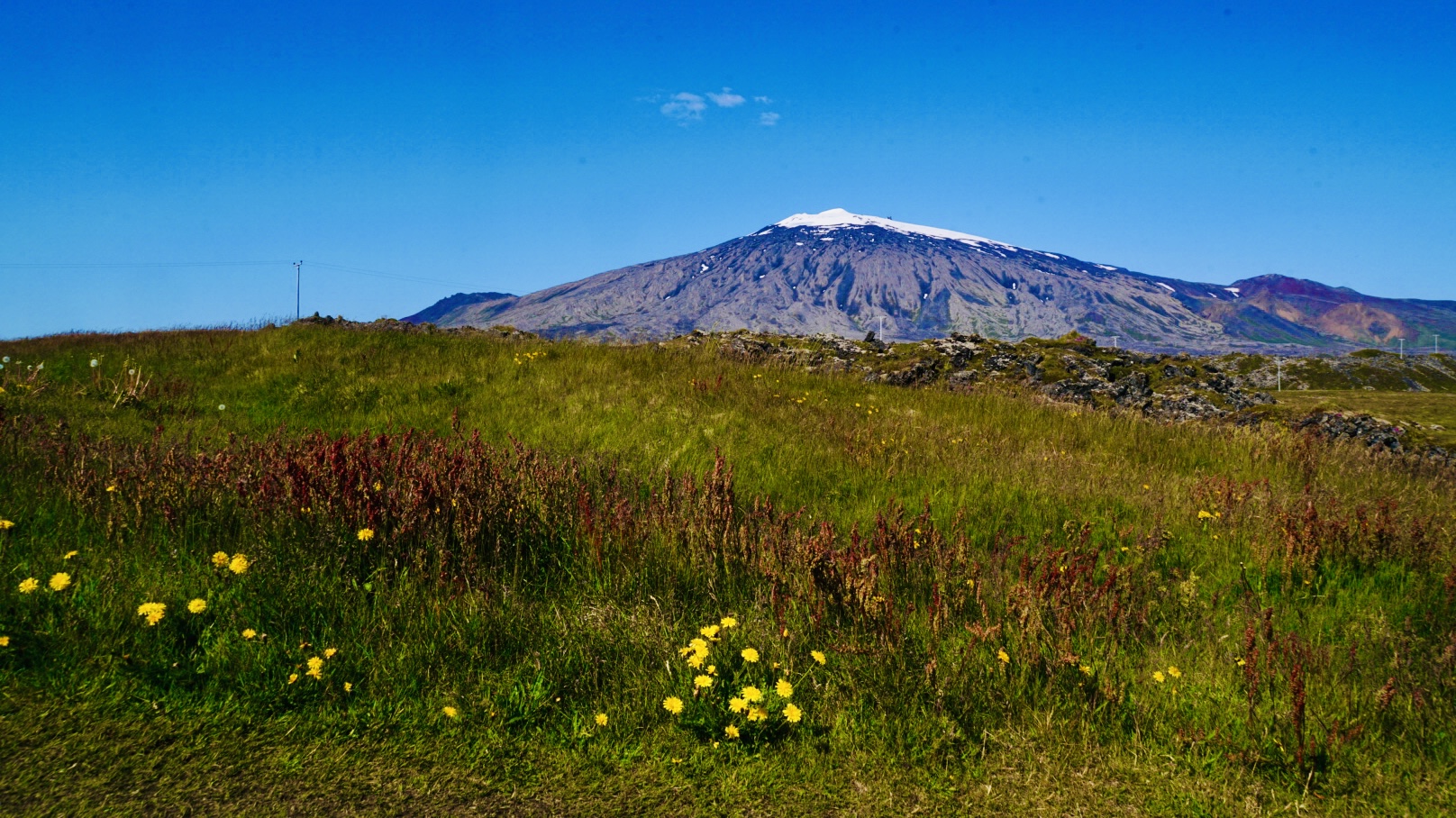 Snaefellsnes National Park, north of the Golden Circle in Iceland
It was counter-intuitive at first sight, but easily understandable after a second of thought: the volcanic eruptions brought out the best fertilizers the land could possibly get, fresh from the core of the earth. No way the surrounding land would not be fertilized.
If the planet earth is a human being, and the geysirs and hot springs are the pores on the T-zones on the face, then active volcanoes are like pimples: both involve something bursting out of a hole from the inside; both are destructive and may leave ugly marks on the surface; nevertheless, they both also cause the glowing pink youthful skin to reborn around the area. Most importantly, both of them are indicators of high energy - aren’t pimples always regarded as a sign of puberty?
It’s also the epitome of rebirth from ashes, the story of how nature heals itself, the perfect evidence of the “Circle of Life” philosophy.
Mufasa: Everything you see exists together in a delicate balance. As king, you need to understand that balance and respect all the creatures, from the crawling ant to the leaping antelope.
Young Simba: But dad, don’t we eat the antelope?
Mufasa: Yes, Simba, but let me explain. When we die, our bodies become the grass, and the antelope eat the grass. And so we are all connnected in the great Circle of Life.