
Walking the Planet: Finding a Minibus
I arrived at a small hotel in Selçuk (“sel-chook”), Turkey one day last month (Sep 2022) with my old friend Christy, to visit the Archeological Site of Ephesus later in the day. The hotel was a 10-minute-drive away from the entrance, yet Google Maps didn’t show us any public transportation option, and walking over would take 50 minutes. After some web crawling, I found a TripAdvisor post that suggested that we take a “dolmuş” (minibus) at the “Selçuk bus terminal”, so we went ahead, asked around for the right minibus to take (they didn’t always have signs showing the destination), hopped on and paid the driver ₺12, waited another 15 minutes for the minibus to fill up before finding ourselves on the road.
Since then, we took the dolmuş three more times in Turkey, but I always felt the process of finding one unsettling. When we head out of Ephesus after it got dark, the parking lot where the minibus that dropped us off was eerily empty and we started worrying whether we would find a bus back after all, until we saw a group of people sitting under the tree across the road from the parking lot and went to ask. Getting from Pamukkale from Denizli train station was also annoying: we knew there would be minibus from Denizli to Pamukkale but had no idea where we could find one, so we just blindly followed the crowd out of the train station. After five long minutes of dragging suitcases on uneven surfaces and crossing three traffic lights, we found ourselves at the front of the bus terminal, with several bus stops nearby and minibuses stopping there. We went over and asked, but none of them was going to Pamukkale, so we had to keep asking our way around before we found, with trials and errors, the right minibus at the B2 level inside this big bus terminal.
I had similar experiences in other countries too, all with the help of Airbnb hosts. In Cancun, Mexico, I did the “hitchhiker’s thumb up” at what I recalled to be some “random minibus” at this highway a few minutes walk away from an amusement park, and got off at somewhere that kinda… seemed… familiar? Then, when I was packing in my Airbnb in Jerusalem, Israel, getting ready to take a tram to get the bus terminal so I could board a bus to Tel Aviv, my host told me I could just get a “sherut” around the corner. There was no visible sign on the road, and when the sherut came it didn’t have the English word “Tel Aviv” anywhere (maybe it did in Hebrew, I wouldn’t know), but it looked distinctive enough and exactly as described by my host, plus it also arrived the exact time he predicted. I got off somewhere I could not recognize at all, but I knew that I was inside Tel Aviv, where Google Map could be help me find a bus-on-the-grid to get to my hostel, with realtime navigations and all.
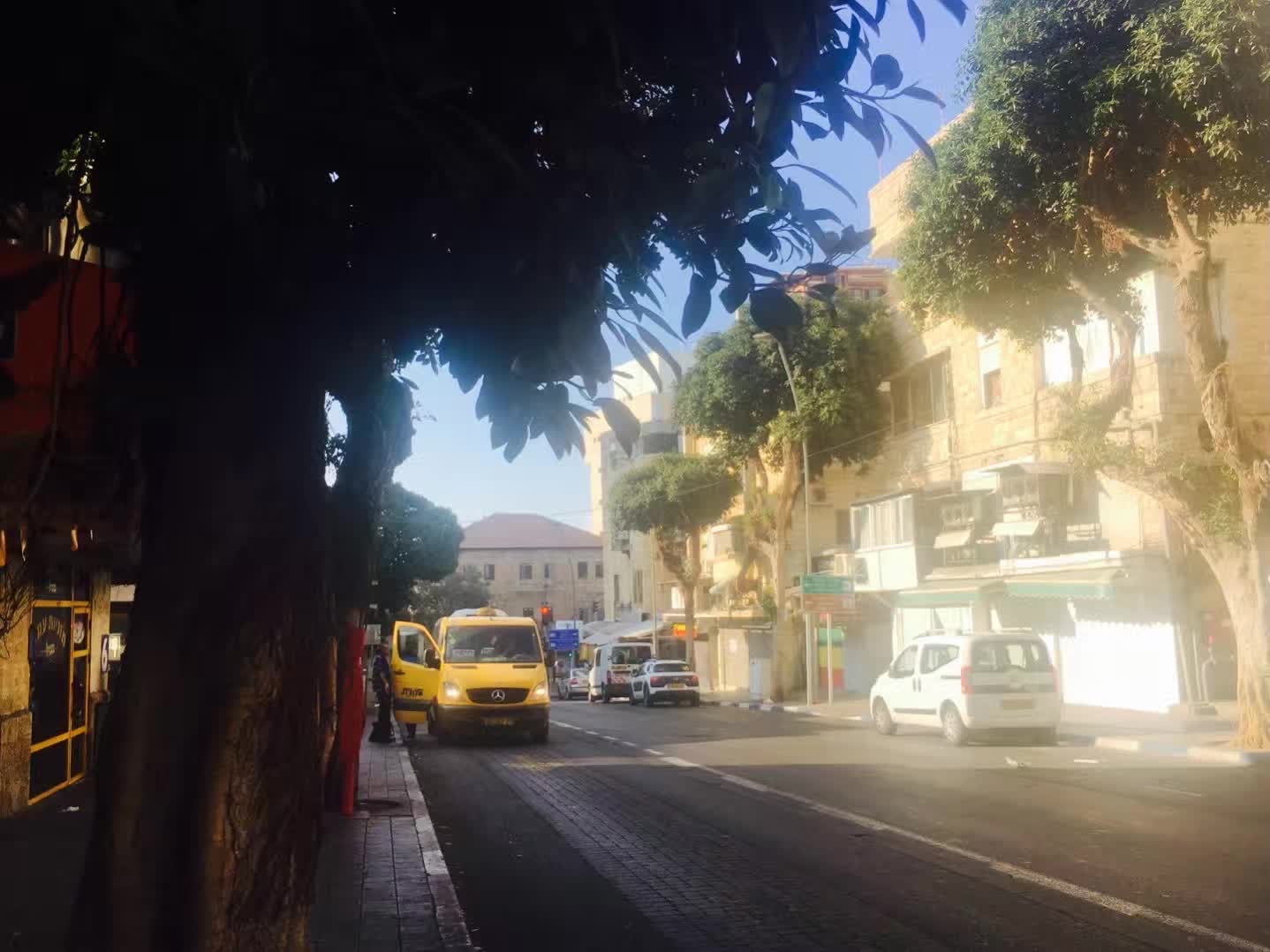
(Haifa, Israel)
For some weird reason, I was always under the false impression that the minibuses did not follow a fixed route. I thought that they made sure they went through the pre-determined “neighborhoods” and that was it. As a result, waving at a minibus by some deserted highway and hopped on a bus seems like a superpower to me - how could you be sure this vehicle was coming to you? Did that “wave” gesture somehow conjured this bus? After a quick fact check, however, I realized that I remembered wrongly all along. At least, both the Israeli “sherut” and the Turkish “dolmuş” operate with fixed routes, so anyone remembering the route (or even just a part of it) should know where to find the right minibus.
I also wondered how the locals could remember the routes so well, and realized that it wasn’t actually needed. The way to get to the most visited places - home, work, school, city center, etc - should have been deeply rooted into their instincts, as it had been into mine. Like with subways and light rails, you only need to remember the origin and the destination - one coordinate each. It was harder to imagine how to get somewhere new though, but riding a minibus isn’t the only way to go around, right?
Now that I tried to decompose the minibus system by fact checking instead of recalling my personal experiences, I found out that it wasn’t that mysterious at all, so why did it always seem like some gigantic maze that I couldn’t navigate through? Why could no amount of preparation make it easier to take a minibus? Except for that one time where the TripAdvisor post gave me clear enough instructions to find the dolmuş at the bus terminal, the only way I got through was by being there and asking the locals, or maybe, by sheer luck, seeing one driving by and waving at it. (That happened when we were getting back to Denizli from Pamukkale.)
I guess the reason why my mind struggles with all the minibuses is this: As a self-appointed global citizen, as a millenial who lives in the age of internet and has never failed to find answers in there, as a adventurous world trotter who prides herself in her knowledge and experience of it, and as an engineer who, deep down, somehow believed that she could pre-plan everything as long as she willed it to, I find it hard to accept the fact that there are still this large part about navigating through the world that I can’t penetrate; things that are barriered by language, cultural context, and traditions that the locals took so much for granted as norms that they wouldn’t have thought talking about them on internet.
As I’m writing this, I’ve been trying to recount my first “minibus” experience, which actually happened back in China. I can’t believe that I have almost forgotten about it, but it was, without a doubt, the most exciting minibus riding experience in my life so far.
It happened in 2010 when I was 18, too young for a stereotypical “obedient and excels-in-exams” Chinese teenager like myself to travel on my own. Anywhere outside my mom’s comfort zone was dangerous. Any stranger who didn’t look the same way my parents’ look or dress the same way they dress was a potential kidnapper or a human trafficker, in whose eyes I was the fat roasted pig in a grand feast.
Therefore, I hadn’t expected this to happen when my two friends decided to spend their mornings in the hotel room, while I couldn’t resist the temptation to visit the Yulong Mountain a second time. I carpooled with a family of four in the same hotel to get there, but we split up once we got through the ticketed gate. That was when it struck me - I was alone, and had no idea how I could get back to the hotel in the Old Town of Dayan(大研古镇).
After four hours wandering around in the park and finding my way back, I reached a sort of “gate” that looked like… the back entrance? (is it really an entrance? No ticking office, no taxi, no parking lot, no nothing. Just a door.) The worst part is… my cellphone is dead. There’s no way I can get in touch with my two friends who decide to spend their morning in the hotel room. And the I saw it. A white van with a handwritten sign saying “?? To Dayan” (I forgot the ?? part). I had never ridden something like this before. I was nervous. But I had no choice but to wave and get on.
I glanced around the van the moment I got my feet on it, and was terror stricken. I hadn’t expected the van to be filled with locals, all of whom had plateau-red cheeks, sun-tanned skin, and a curious stare at the new passenger who looked so out of place on this vehicle. When they talked amongst themselves my suspicion was confirmed - they didn’t even speak Mandarin at all.
Great. I got on a van with 19 other human traffickers. I couldn’t call my friends or call 110 (Chinese 911) because my phone was dead. In a few hours, I would either die, or be tied by ropes and taken to some wild undeveloped tribe where I would spend the rest of my life crying. My two friends would soon realize that I went missing, and they would call my parents, and my parents would be devastated and forever regretting the decision letting me go out of town without proper adult supervision.
My hand sweat over the nonfunctioning Nokia I gripped as hard as I could. I counted the minutes that had passed, the stops the van took, and the number of passengers that were left on the van…
My heart lightened a bit every time I saw one passenger left the van, until it was only myself and the driver left. I was still edgy - what if the driver turned out to be the villain in my story? It was him and I alone now. I somehow wished all the passengers who left the van back in it, so that the driver wouldn’t dare to do anything evil. Fortunately, before long, the view outside became recognizable. I knew we entered the Old City of Dayan.
The van came to a halt. I paid the driver (much less than I should because I didn’t have changes on me, but he let me go quite easily), walked back to the hotel, and felt like I was back from the hell.